Verdict of Inquest
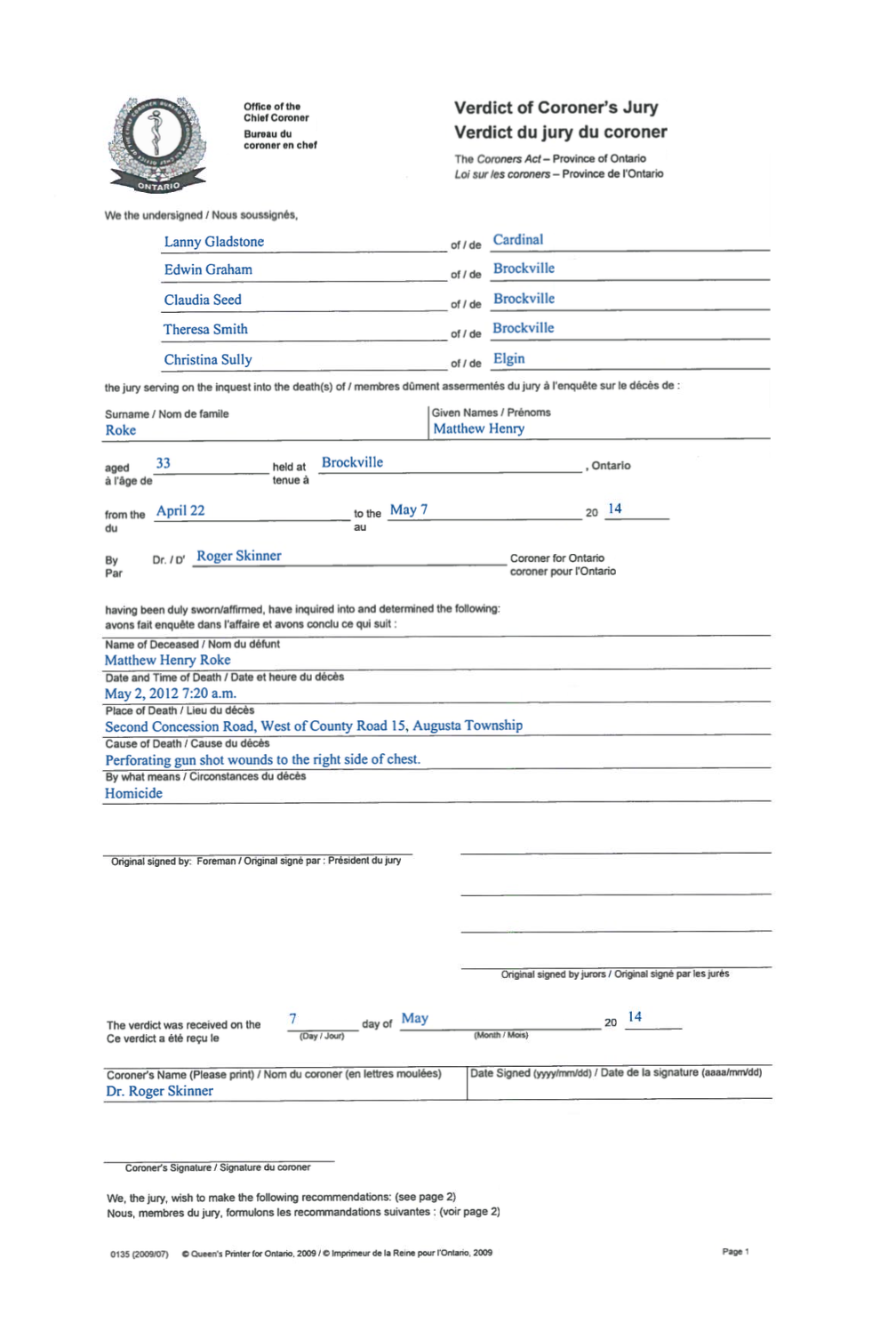
Outlined below are the jury recommendations from the inquest held by the regional coroner’s office from April 22 to May 7, 2014. Download the PDF here.
Inquest into the death of:
Matthew Henry Roke
JURY RECOMMENDATIONS
Ministry of Community Safety and Correctional Services (MCSCS), Ontario Police College (OPC), Ontario Provincial Police (OPP), Ontario Association of Chiefs of Police (OACP)
- The MCSCS and OPC should fund and/or perform further research into the effective training of police officers in regard to interaction with emotionally disturbed persons (EDP).
- The OPC and police forces should increase the mental health component of training of police officers in regard to illnesses and interaction with EDP. This training should be included in the annual mandatory training of police officers and should emphasize techniques of de-escalation, with consideration given to a Behaviour Management System model.
- Police forces should develop protocols with local community and hospital mental health providers in order to facilitate the interaction with EDP and to improve the sharing of information regarding EDP in the community. Consideration should be given to utilizing crisis workers in interactions with EDP.
- Police forces should increase the number of front line officers trained in the use of, and equipped with, conducted energy weapons (CEW).
- Police forces should ensure, where possible, that CEW’s are available in all interactions between police and persons with weapons other than firearms.
Ministry of Community Safety and Correctional Services (MCSCS), Ontario Provincial Police (OPP), Ontario Association of Chiefs of Police (OACP), Ministry of Health and Long Term Care (MOHLTC), Information and Privacy Commissioner for Ontario - The above named should produce an interpretation bulletin for police officers and mental health care providers in order to clarify the privacy issues in regard to the sharing of information between police and mental health care providers. This interpretation should focus on the health and safety of the individual whose information is being shared and on public safety.
Ministry of Community Safety and Correctional Services (MCSCS), Ontario Provincial Police (OPP), Ontario Association of Chiefs of Police (OACP), Ministry of Health and Long Term Care (MOHLTC) - The above named should produce an interpretation bulletin in order to clarify the criteria for apprehension under Section 17 of the Mental Health Act (MHA). This interpretation should include reference to the importance of information provided by the family and/or caregivers of the individual being assessed. Consideration should be given to the production of an assessment tool for the use of police officers.
Ministry of Health and Long Term Care (MOHLTC), Southeast LHIN - The MOHLTC should increase the availability and funding of hospital based addiction treatment services in Schedule 1 psychiatric facilities and explore the possibility of introducing a harm reduction model of treatment for dual diagnosis patients with the sole intent of engaging the patient to facilitate treatment for the mental illness while in a Schedule 1 psychiatric facility.
- The MOHLTC should produce an interpretation bulletin for mental health care providers in order to clarify the concept of “circle of care”, and the consent required to permit sharing within that circle, with consideration given to including the family in this circle where appropriate.
- The MOHLTC should review the Mental Health Act as it pertains to the capacity and consent criteria with the intent of facilitating apprehension, assessments, access to treatment and other services for patients with a chronic mental illness.
- The MOHLTC should review the Mental Health Act as it pertains to sharing of information within the circle of care, with the intent of facilitating communication between parties within the circle of care.
- The MOHLTC should produce an interpretation bulletin for mental health care providers in order to clarify the process of determining capacity.
- The MOHLTC should study the need for long term in-patient services for patients with severe, chronic mental illness.
- The MOHLTC and the Southeast LHIN should ensure that the addictions and mental health services currently offered and the funding for same are preserved or enhanced when selecting a model for restructuring. Consideration should be given to options that will improve the experience of persons with mental illness, including addictions, and their family members or other caregivers.
- MOHLTC and the Southeast LHIN should ensure that the Court Diversion and Support Programs currently offered and their funding be preserved when selecting a model for restructuring.
- The MOHLTC and Southeast LHIN should continue to explore the alignment of addiction and mental health care services with the intent of improving service to patients and their families.
- The MOHLTC should fund at least one position within each LHIN, the duties of which would include providing information with respect to the types of addictions and mental health services available in the community, and the requirements for accessing such services, if any. The contact information for the person(s) in this position should be made as simple and as easy to locate as possible, so that persons in need of addictions and/or mental health services, their family members, or care providers, need only make one contact in order to be connected with the appropriate information and services.
- The MOHLTC should fund and produce a public service announcement appealing to people to seek treatment with regard to mental illness, on behalf of themselves or a loved one.
Ministry of Health and Long Term Care (MOHLTC), Ministry of Training, Colleges and Universities, Deans of Ontario Schools of Medicine - The above named should undertake a review of addictions curriculum for undergraduate medical education as well as post-graduate education in the specialties of family medicine and psychiatry, with consideration given to significantly increasing the Addictions component of study.
Brockville General Hospital (BGH) - The BGH department of psychiatry should continue to review the use and effectiveness of community treatment orders (CTO).
- The BGH department of psychiatry should consider increasing the use of CTO for individuals with chronic mental illness.
- The BGH department of psychiatry should review the documentation of treatment and discharge plans. This documentation should record all aspects of the planning, including meetings with community service providers.
- The BGH department of psychiatry should ensure that referral to all appropriate out-patient services is addressed in each discharge plan.
- The BGH department of psychiatry should explore ways to increase the involvement of patients’ family and caregivers in the admission, treatment and discharge planning.
- The BGH department of psychiatry should involve the entire treatment team in the discharge planning process.
- The BGH department of psychiatry should explore means to contact patients and appropriate caregivers within the first week following discharge from hospital in order to ascertain if the discharge plan has been effective.
- The BGH department of psychiatry should collaborate with the appropriate community agencies to generate and reintroduce a toolkit (literature) for patients and or their families upon discharge.
- Where a patient is relocating to another Mental Health jurisdiction, the BGH department of psychiatry should notify the appropriate mental health personnel within said jurisdiction.
- BGH department of psychiatry should continue to explore options to reduce the time spent in the emergency department by patients presenting pursuant to a Form 1, Form 2 or Section 17 of the MHA, with consideration given to preserving the dignity of people with a serious mental illness.
- BGH department of psychiatry should review the acuity level assigned to patients presenting with a serious mental health crisis.
- BGH should consider the removal of identifying numbers from the fleet vehicles used by the Assertive Community Treatment Team (ACTT).
- BGH department of psychiatry should explore ways to identify patients at risk of mental deterioration where a second opinion regarding treatment and discharge planning would be appropriate.
- The BGH department of psychiatry should conduct a full internal Quality of Care review with respect to the circumstances of Matthew Roke’s admission to, treatment in and discharge from the department from January 31, 2012 to February 28, 2012.BGH, Leeds Grenville Mental Health (LGMH), Tri County Addictions Services
- The above named organizations should review the process of the weekly meetings between in-patient care providers and community mental health care providers. This review should include leadership, membership, roles, documentation, consent, implementation of assessments and treatment, and follow up.BGH, Canadian Mental Health Association-Leeds Grenville (CMHA), Leeds Grenville Mental Health (LGMH), Brockville Police Services (BPS), OPP, Tri-County Addictions Services, Southeast LHIN
- The above named organizations should cooperate to develop information/publications regarding mental health services funded by the Southeast LHIN that can be utilized by police, mental health care providers, patients and their families. This should include information about the process of obtaining a Form 2 – Order for Examination under Section 16 of the MHA.
- The above named organizations should hold an annual Mental Health Forum to bring community agencies together. A portion of this forum, or a separate forum should be open to the public. Canadian Mental Health Association-Leeds Grenville (CMHA), Leeds Grenville Mental Health (LGMH), Southeast LHIN, MOHLTC
- Support services to families of individuals with mental illness should include direct assistance with the application for a Form 2 – Order for Examination under Section 16 of the MHA.
- Support services to families of individuals with mental illness should include respite services.